
Quick Summary
Tight bass is “hit and stop.”
Clean bass keeps vocals clear.
Boomy bass is fun but messy in small rooms.
Deep bass needs real sub pressure below 40 Hz.
Punchy bass depends on alignment.
Who this guide is for
Beginner DJs.
Small rooms.
Powered speakers with subwoofer.
Weddings. Parties. Home venues.
Disclosure
This guide is written by Murphy, an official team member at PRORECK.
It includes PRORECK product references.
See full disclosure at the end.
Why “Good Bass” Means Different Things
Many first-time buyers say: “I want good bass.”
But “good bass” is not one thing.
It depends on your music, your room, and your setup.
This guide helps you understand subwoofer tuning fast.
You’ll learn 5 bass styles.
You’ll learn low end control.
You’ll get quick fixes and 10-second tests.
Quick Bass Style Selector
-
Weddings & speeches → Clean bass
-
Club kick definition → Tight / Punchy
-
Casual party vibe → Boomy (moderate)
-
EDM / hip-hop drops → Deep
-
Open-format balance → Clean + Punchy
Common setups:
-
wedding DJ speaker setup → clean + controlled punch
-
backyard party speaker setup → a little boom, not muddy
-
small room DJ sound setup → placement first, then EQ
-
outdoor DJ sound system setup → deep + punch with headroom
-
corporate event speaker setup → clean and tight, speech-safe
Subwoofer Placement for Small Rooms (Fast Wins)
Small rooms create room modes fast.
Placement changes bass more than EQ.
Quick placement rules
-
Corner = louder, but often boomy.
-
Move the sub 1–2 feet off a wall.
-
Avoid pushing the sub into a tight corner first.
-
Fix placement before heavy EQ.
Subwoofer Crawl (Beginner method)
Use this when bass is uneven or boomy.
-
Put the sub near your listening position (chair/booth).
-
Play a steady bass loop at safe volume.
-
Walk around the room edges.
-
Find spots where bass sounds even (less boom, more definition).
-
Put the sub in that spot.
-
Re-test at your listening position.
Why it works: you are searching for the best room interaction first.
Then you tune with filters and small EQ.
Subwoofer Crossover Settings (Beginner-Safe)
Crossover decides who does what.
Subs carry the body.
Tops carry attack and clarity.
Beginner goals
-
Keep vocals clean.
-
Keep kick definition.
-
Avoid “one-note” boom.
Common crossover mistakes
-
Crossover too high → muddy low-mids and boomy feel.
-
Crossover too low → weak kick body and thin low end.
-
No alignment → punch cancels out.
Simple workflow (works in small rooms)
-
Start neutral. No big bass boosts.
-
Set crossover to a stable starting point.
-
Set levels. Avoid clipping.
-
Align if available (delay).
-
Use small EQ cuts only.
Note: Your exact crossover baseline should match your system and room.
For CLUB-6000, we will publish an engineer-verified baseline below.
Aux-Fed Sub (Optional Advanced Tip)
This is optional.
It is not required for beginners.
What it is
Aux-fed sub means you send only selected channels to the sub.
Example: kick and bass go to the sub.
Vocals do not.
Why it can help in small rooms
It can reduce muddy bass.
It can keep vocals cleaner.
It can improve clarity at lower volume.
When to skip it
-
If you do not have routing control.
-
If you want the simplest setup.
-
If you are still learning placement and crossover basics.
Repeatable Workflow
In a small room, bass changes fast.
One foot of movement can change the sound.
Rule: placement first, EQ second.
How to Reproduce These Results (Beginner Method)
This is the repeatable workflow.
-
Use one kick loop and one walking bassline.
-
Start neutral (no big boosts).
-
Move the sub first.
-
Set HPF/LPF and crossover.
-
Align if available.
-
Small EQ cuts only.
-
Re-test with the same reference track.
5 Bass Styles (Tight / Clean / Boomy / Deep / Punchy)
1) Tight Bass Settings (Subwoofer Tuning)
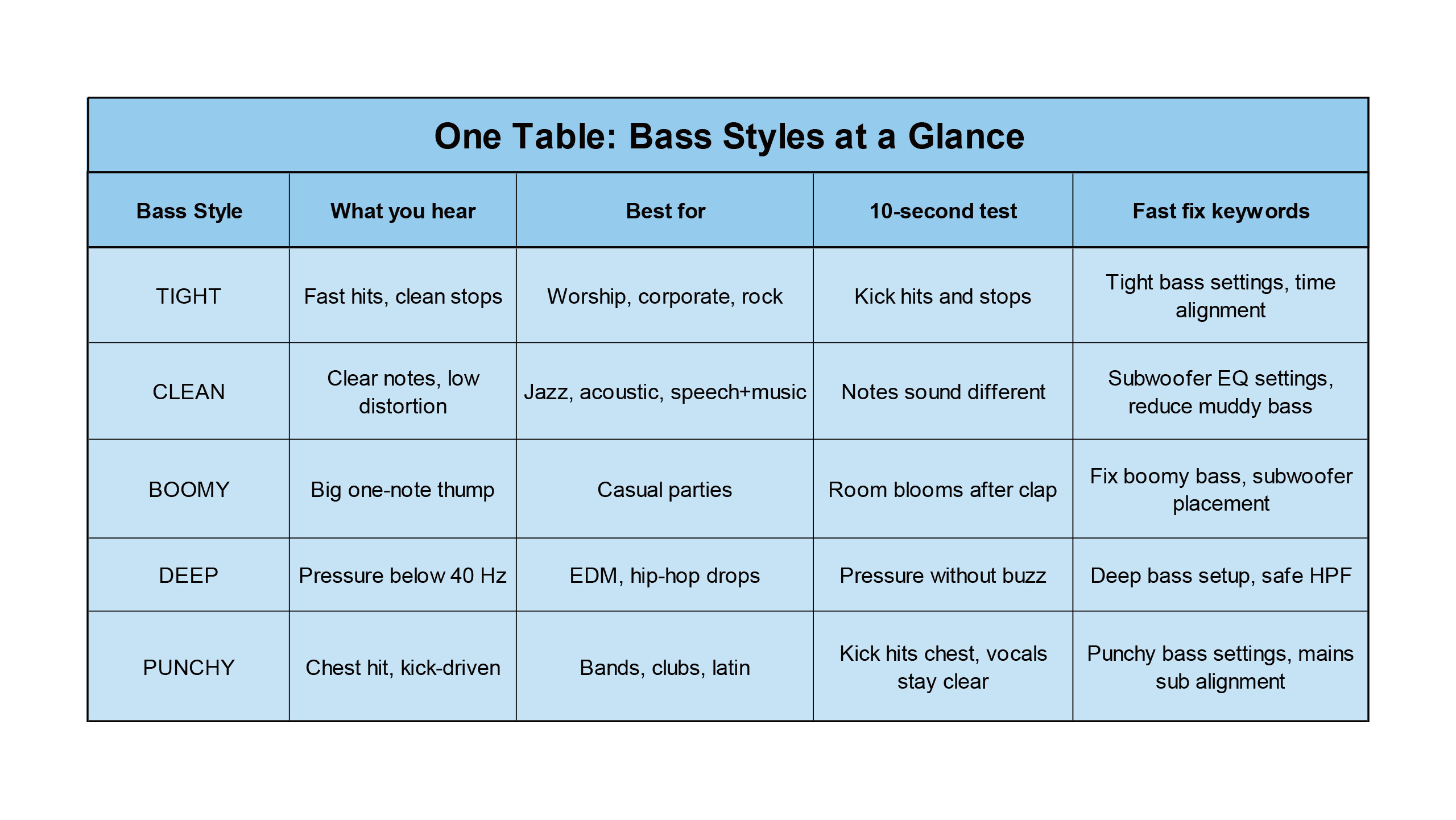
Sound: Tight bass is fast and controlled. The kick hits and stops. Notes stay separated. Vocals stay clear.
Best for: rock, funk, jazz, gospel. Worship and corporate events.
Common mistake: too much 80–120 Hz. Subs and tops out of time.
Quick fix:
-
Placement: don’t start in a corner
-
HPF: 30–35 Hz
-
EQ: trim 80–110 Hz if thick
-
Crossover: keep it simple and stable
-
Time alignment: even basic delay helps
-
Limiting: moderate, not crushing
10-second test: kick loop. If it hits and stops, you’re close.
2) Clean Bass (Low End Control for Clarity)
Sound: Clean bass is even and natural. You can hear pitch and texture. It stays clear as volume goes up.
Best for: acoustic sets. Jazz. Spoken word + music.
Common mistake: smile EQ. Heavy limiting.
Quick fix:
-
Start neutral. Small moves only
-
Cut the loudest room note (often 45–70 Hz or 80–110 Hz)
-
Moderate limiting
10-second test: walking bassline. If notes sound different, it’s clean.
3) Boomy Bass (How to Fix Boomy Bass Fast)
Sound: Boomy bass is big and fun but has long decay. The room swells after kicks. Vocals get buried.
Best for: casual parties (in moderation).
Common mistake: sub in a corner + bass boost.
Quick fix:
-
Subwoofer placement: move away from corners/walls
-
EQ: cut ~100 Hz a few dB
-
In small rooms: placement > EQ
-
If vocals get buried, reduce low end first
10-second test: clap once at the listening spot. If the room blooms, move the sub.
4) Deep Bass Setup (Real Sub Drops Below 40 Hz)
Sound: Deep bass is real sub pressure below 40 Hz. It feels like air moving and floor pressure.
Best for: EDM, hip-hop, pop drops.
Common mistake: forcing deep bass from tops. Boosting deep lows with no headroom.
Quick fix:
-
HPF: ~28–30 Hz (safe)
-
Let the sub carry depth
-
Outdoors: cluster subs to couple
-
If you hear buzz, you’re pushing too low too hard
10-second test: sub drop. Pressure without harshness = deep.
5) Punchy Bass Settings (Slam)
Sound: Punchy bass is chest-hit impact with quick recovery. The kick cuts through without turning boomy.
Best for: live bands. Pop/rock/Latin. Club nights.
Common mistake: bad crossover choices. No alignment, so punch cancels out.
Quick fix:
-
Crossover: subs carry body, tops carry attack
-
LPF: don’t set it too high
-
Mains/sub alignment: align first (priority #1)
-
Phase: fix cancellations before boosting EQ
-
After alignment: small lift 70–80 Hz if needed
10-second test: four-on-the-floor kick. Chest hit + vocals clear = punchy.
Beginner Setup Checklist (2 Powered Speakers and Subwoofer Setup)
-
Place the sub first
-
Set HPF / LPF
-
Set crossover
-
Set level (avoid clipping)
-
Set delay (if available)
-
Do alignment
-
Small EQ cuts (not big boosts)
-
Re-test with one reference track
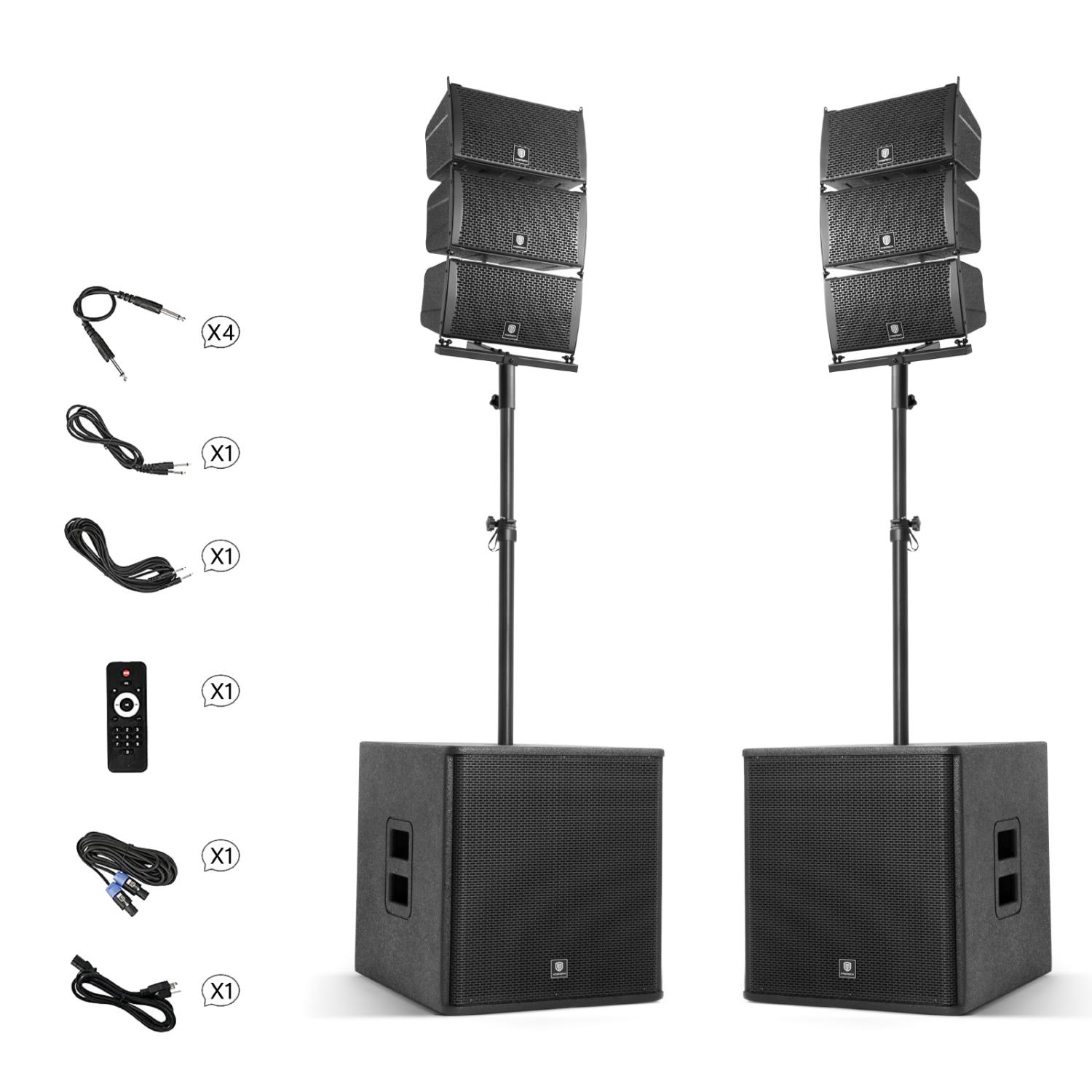
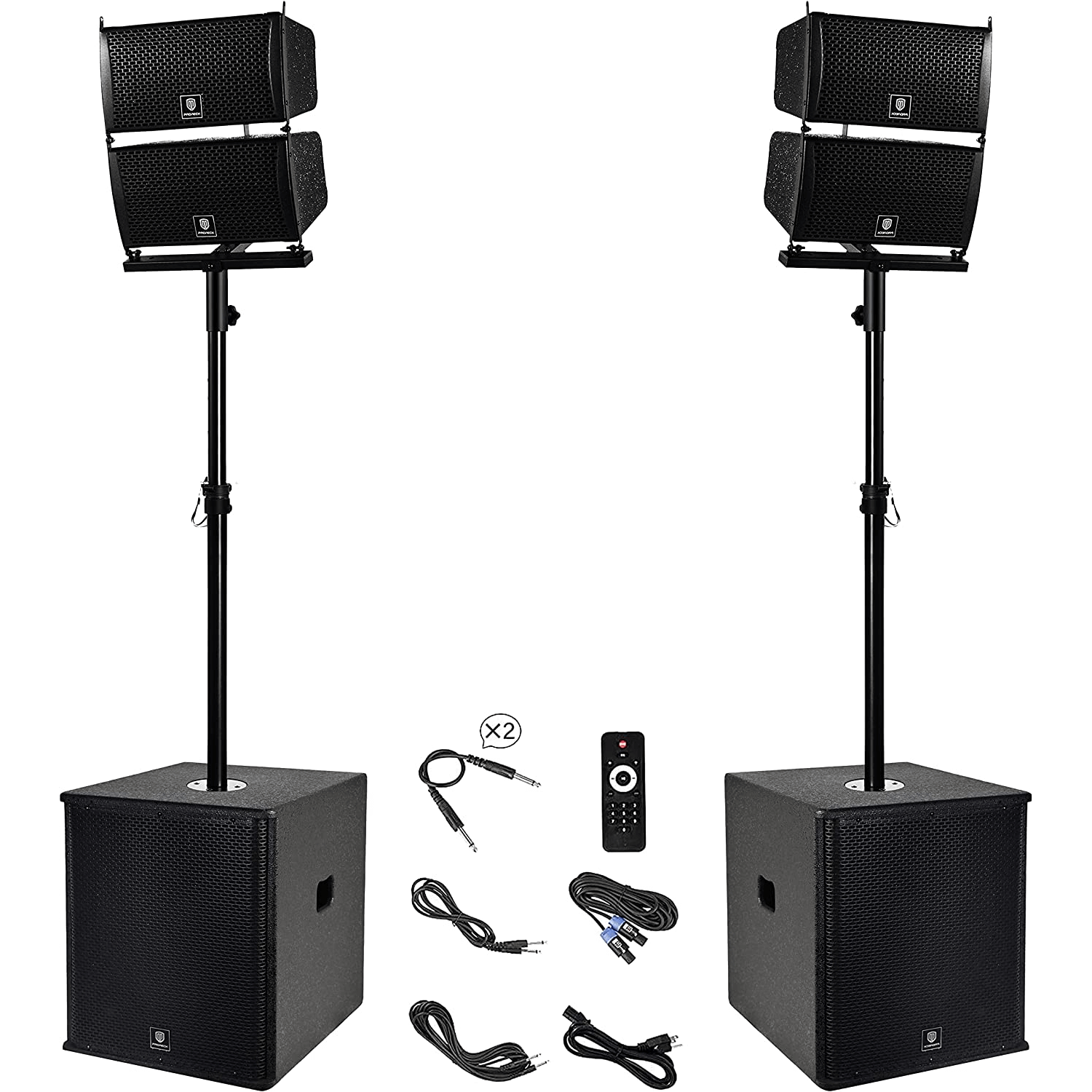
CLUB-6000 Controls That Help Beginners (Official)
Use onboard controls to fix small-room bass fast:
-
Sub frequency control (cutoff range on the system)
-
Phase switch (0° / 180°)
These controls help when bass feels boomy or weak.
They also help when punch disappears.
CLUB-6000 Starter Settings (Engineer-Verified Baseline)
| Feature | Specification |
| Top Speakers HPF (High-Pass Filter) | 150 Hz |
| Subwoofer Crossover / Sub Frequency Control | 40–160 Hz (control range) |
| Subwoofer LPF (Low-Pass Filter) | Max 160 Hz |
| Phase | 0° / 180° (start at 0°, flip if bass feels weak around the crossover) |
How to use this baseline (small room):
Start with HPF 150 Hz on the tops.
Use the sub control within 40–160 Hz and keep it stable.
Avoid chasing bass with big boosts.
Fix placement first.
Video Proof
Third-party field review (live-use experience)
This is a third-party review.
It shows real-use experience and tone impressions.
FAQ
Q1: How to make bass less boomy in a small room?
Move the sub away from corners first. Then cut ~100 Hz a few dB.
Q2: Why does my bass sound muddy?
Room modes and placement. Cut the loudest room note. Avoid big boosts.
Q3: How to get punchy bass for DJ music?
Align subs and tops first. Then set crossover for body vs attack.
Q4: Do I need a subwoofer for deep bass?
Yes. Deep bass usually means below 40 Hz. Tops struggle there at event volume.
Q5: What’s the fastest way to check tight bass?
Kick loop. It should hit and stop. No long decay.
Q6: How to align subs and tops?
Use delay if available. Fix alignment before boosting bass.
Q7: What subwoofer settings should I start with on the PRORECK CLUB-6000 in a small room?
Start with Top HPF at 150 Hz. Use the sub frequency control within its 40–160 Hz range. Keep LPF at or below 160 Hz. If bass feels weak near the crossover, flip the phase (0°/180°) and re-test.
About the Author
Murphy is an official team member at PRORECK.
He writes beginner-focused guides for DJ and event sound setups.
Disclosure & Updates
Disclosure: The author (Murphy) is an official team member at PRORECK. This article includes PRORECK product references.
Last updated: December 29, 2025
Hearing Safety Note
High SPL can damage hearing.
Use safe listening habits.
Keep levels reasonable during setup and testing.